
-
Snake Stripe is fully vulcanized into the Extra Heavy Duty CPE outer jacket during the lead curing process, creating an extremely visible and durable reflective stripe that runs down the entire length of the cable, providing the following benefits:- Improved cable visibility in low-light and high-traffic environments, enhancing overall mine and personnel safety- Extended cable life through reduction of cable damage due to equipment “run overs”- Reduced production downtime due to cable damage issues • Improved cable identification for tracking of critical circuit cables- Highly resistant to common mining cable operating conditions such as abrasion, cut, tear, oil, and chemical and water exposure
-
TransPowr® ACSS/TW is a trapezoidal aluminum conductor steel-supported concentric-lay-stranded conductor. The aluminum strands are trapezoidal in shape. The wedge-shaped aluminum strands enable a more compact alignment of the aluminum wires. Conductor designs that maintain the same circular mil cross-sectional area of aluminum as a conventional round conductor result in a TW conductor that is 10 to 15 percent smaller in overall diameter. Conductor designs that maintain the same overall diameter as a conventional round conductor result in a TW conductor that has 20 to 25 percent more aluminum cross-sectional area packed in. The ACSS/TW conductors are manufactured in accordance with the requirements of the latest issue of ASTM B857. The steel strands form the central core of the conductor, around which is stranded two, three or four layers of aluminum 1350 O temper (annealed) wires. The steel core may consist of a concentric stranded cable of 7, 19 or more wires. Numerous combinations of aluminum and steel strands and layers are possible. The sizes and constructions listed on the following pages are common examples used in overhead lines. Standard ACSS/TW designs are manufactured with regular-strength Class A zinc-5% aluminum mischmetal alloy-coated steel core (/MA2).
-
ACSR/SD conductors are manufactured with two layers of 1350 H19 trapezoidal-shaped aluminum wires concentrically stranded around a steel core of round coated steel wires. On certain larger conductor constructions, the trapezoidal-shaped wires are surrounded by a layer of round 1350 H19 aluminum wires. The steel core and the two layers of trapezoidal-shaped aluminum wires are separated by a gap to provide the self-damping characteristics. Steel core wires are protected from corrosion by aluminum-clad, galvanized, or zinc-5% aluminum mischmetal alloy coating. Standard, high, extra- and ultra-high-strength steel is also available. The ACSR/SD conductors are manufactured in accordance with the requirements of the latest issue of ASTM B701.
-
TransPowr® AAC/TW is a trapezoidal 1350 H19 aluminum (AAC) concentric-lay-stranded conductor. The aluminum strands are trapezoidal in shape. The wedge-shaped aluminum strands enable a more compact alignment of the aluminum wires. Conductor designs that maintain the same circular mil cross-sectional area of aluminum as a conventional round conductor result in a TW conductor that is 10 to 15 percent smaller in overall diameter. Conductor designs that maintain the same overall diameter as a conventional round conductor result in a TW conductor that has 20 to 25 percent more aluminum cross-sectional area packed in. The AAC/TW conductors are manufactured in accordance with the requirements of the latest issue of ASTM B778. The conductor consists of two, three, four or five layers of aluminum 1350-H19 wires. The sizes and constructions listed on this and the following pages are examples used in overhead lines.
-
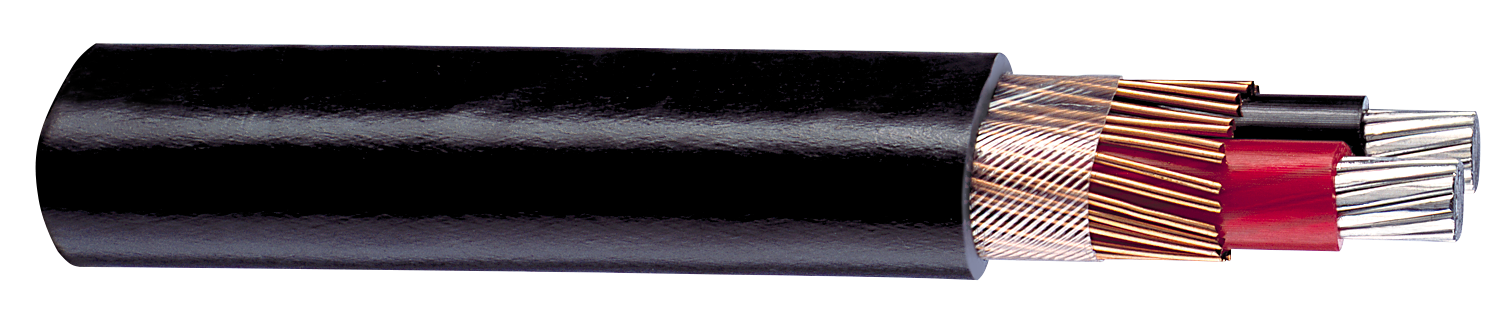
Quadruplex NS75/NS90 Service Drop Cable is intended to deliver three phase power from the secondary overhead power line or pole-mounted transformers to the service entrance conductors at the user’s building or other structure. NS75/NS90 cable may also be used as pole line secondary with service splices at the pole (also refer to CEC rule 12-318). NS75/NS90 cable is rated for use on systems having nominal voltages of 600 V or less.
-
Duplex NS75/NS90 Service Drop Cable is intended to deliver single phase power from the secondary overhead power line or polemounted transformer to the service entrance conductors at the user’s building or other structure. NS75/NS90 cable may also be used as pole line secondary with service splices at the pole (also refer to CEC rule 12-318). NS75/NS90 cable is rated for use on systems having nominal voltages of 600 V or less.
-
TransPowr® ACCC®/TW is an aluminum conductor composite core trapezoidal concentric-lay-stranded conductor. The aluminum strands are trapezoidal in shape and enable a more compact placement of the aluminum strand wires. ACCC/TW conductors are designed to maintain the same overall diameter as a conventional round wire ACSR. The compact trapezoidal conductors, coupled with a smaller composite core, result in a TW conductor that has approximately 28% more aluminum cross-sectional area than ACSR. The design features follow the applicable requirements of ASTM B857 (Shaped Wire Compact Concentric-Lay-Stranded Aluminum Conductors, Coated-Steel Supported (ACSS/TW)). The annealed aluminum strand wires are in accordance to ASTM B609. The composite core strength member is a proprietary high-strength carbon and glass fiber composite core in accordance to ASTM B987, around which are stranded two, three or four layers of the annealed 1350 aluminum wires.
-
Smooth Body bare all-aluminum 1350 (A1 or ASC) are compact concentric-lay-stranded conductors consisting of one or more layers of wire wrapped helically around a straight round central wire. Smooth Body conductors are manufactured in accordance with the requirements of the latest applicable issue of CSA C49.5. A1 or ASC (Aluminum Stranded Conductor) are CSA reference terms. The Canadian constructions are similar in design (strand component size and configuration) to the ASTM B400 specification. Differences lie in the methods used to calculate the rated strength and dc resistance values. The commonly used strandings are 7, 18, and 19. The sizes and strandings listed on the following pages are common examples used in overhead lines. Metric (mm2) sizes are also available.