


BendBright™ XS 200 µm Single-Mode Optical Fiber
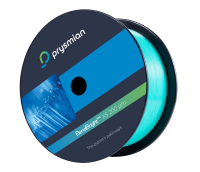
BendBright™ XS fibers, available in 200, 180 and 160 µm sizes, enable cable designers to significantly reduce the diameter of micro outside plant (OSP) cable designs. This feature allows for increased fiber density in ducts and on reels while reducing cable weight. Additionally, it can substantially decrease the total cost of ownership for a network while minimizing the environmental impact of its deployment, making your network infrastructure more eco-friendly.
BendBright XS 200 µm surpasses the ITU-T G.657.A2 standard, and is fully backward compatible with G.652.D IEC 60793-2-50 low water peak specifications. BBXS features an 8.8 µm Mode Field Diameter at 1310 nm, and is rated to a 7.5mm bend radius.
Prysmian’s Advanced Plasma and Vapor Deposition (PCVD and APVD™) manufacturing process ensures the highest quality and purity of fibers. This unique process allows unmatched performance, especially in high-density, high-fiber-count cables.
Thanks to the quality of modern coatings with Prysmian’s patented ColorLock™, there is no need to compromise on overall fiber quality or performance. With BendBright XS cables, you can trust in the reliability and efficiency of your network
Bend Insensitive Fibers
Bend-insensitive single-mode fibers (ITU-T G.657.x) play a crucial role in the global transition to flexible and reliable connectivity. These fibers are uniquely capable of maintaining the entire fiber spectrum, particularly at longer wavelengths (1625 nm and above), by significantly reducing losses from macro- and micro-bending.
Key Features
- Bend Insensitive Design: BendBright XS is a truly bend-insensitive fiber optic cable, built to dramatically reduce signal loss due to macro-bending and micro-bending, even at small radii or tight routing spaces.
- Compact and Lightweight: Available in 200 µm,180 µm and 160 µm sizes, these fibers enable the highest density cable designs and reduced cable diameters, lowering both the weight and the footprint of aerial and duct-installed cable.
- Cost and Environmental Benefits: Smaller cables reduce the total cost of ownership, ease installation in existing duct pathways, and minimize the environmental impact during deployment.
- Standards Compatibility: BendBright XS bend-insensitive single-mode fiber exceeds ITU-T G.657.A2, and is fully backward compatible with G.652.D optical fibers, ensuring seamless integration into modern and legacy networks.
- Reliable Signal Integrity: Special trench-assisted cladding design and advanced coatings confine light within the core, guaranteeing excellent performance across the full telecom spectrum—including longer wavelengths up to 1625 nm and above.
- Easy Handling and Splicing: The high-quality coatings allow for easy fiber management, durable installation, and compatibility with standard fusion splicing—critical for field and data center deployments.
- Future-Proof: Designed for evolving applications such as 10G-PON, WDM-PON, and multi-band transmission environments.
Applications
BendBright XS bend-insensitive single-mode fiber is engineered for demanding network environments where high-density, resilience, and versatility are paramount. This fiber enables reliable connectivity and minimal signal loss even in challenging installations.
- Specified down to a 7.5mm bend radius, 1 turn loss ≤ 0.50dB @ 1550nm
- High-density, high fiber count micro cables such as Prysmian’s Sirocco™ and MicroFlex™
- Access networks for broadband (FTTH, FTTA, PON)
- Long-haul and metro optical networks
- Data center interconnect (DCI) and distributed access architectures
- Hyperscaler, Neoscaler and spread across data centers
- AI infrastructure and next-generation network roll-outs
- Fiber-to-the-home (FTTH) and fiber-to-the-antenna (FTTA)
- Multiple Dwelling Unit (MDU) installations
- Installations requiring ITU-T G.657.A2 and G.652.D compliance
Explore BendBright XS Products
Microduct cables featuring BendBright XS 200 µm fiber can be installed in existing ducts, saving time, reducing civil works, and lowering pathway fees. Additionally, BendBright XS 200 µm features a smaller outer diameter, significantly decreasing the weight and footprint of cables within fiber management systems such as raceways and trays.
FAQs
What is the BendBright XS 200 µm Single-Mode Optical Fiber?
BendBright XS 200 µm is a bend-insensitive single-mode fiber engineered with a reduced outer diameter, enabling compact cable designs and high-fiber-density deployments while maintaining superior signal integrity and future-proof compatibility. Its enhanced macro-bending behavior further ensures that all transmission bands up to 1625 nm (L-band) will remain available for future use in this bandwidth-hungry environment.
How is BendBright XS different than standard optical fiber?
Unlike conventional fibers, BendBright XS bend-insensitive fiber optic cable features trench-assisted cladding and advanced coatings that significantly reduce signal loss from tight bends or micro-bending. BBXS exceeds ITU-T G.657.A2 standards for bending performance, making it ideal for modern networks with space constraints and rigorous routing needs.
Why is bend performance important in fiber optic networks?
Improved bend performance allows for smaller cable designs and higher installation density, while maintaining reliable high-speed data transmission even in installations with sharp turns or confined spaces. This benefit is vital for efficient network expansion, minimizing signal attenuation and ensuring robust connectivity. Enhanced macro-bending performance further ensures that all transmission bands up to 1625 nm (L-band) will remain available for future use in bandwidth-hungry environments.
Where is BendBright XS typically used?
Bend-insensitive single-mode fiber, such as BendBright XS, is used in access networks, long-haul backbone deployments, indoor/outdoor installations, AI and high-density data centers, FTTH, FTTA, and distributed network architectures—anywhere a combination of compact size and high performance is required. It is ideally suited for microduct cables, such as Prysmian’s Sirocco™ or MicroFlex™ families.
What makes Prysmian a leader in optical fiber manufacturing?
Prysmian’s Advanced Plasma and Vapor Deposition (PCVD) manufacturing processes ensure the highest optical fiber quality and reliability. Prysmian’s proprietary ColorLock™ coating process further enhances the protection and longevity of cables in the network. Color is normally applied after the secondary coating to fibers, but Prysmian’s ColorLock™ is applied on the draw tower as part of the secondary coating. Recent studies show this process, and others enable Prysmian’s cables to last 50+ years through aging tests. Prysmian sets industry benchmarks for innovative design, standards compliance, and sustainability, providing networks with state-of-the-art bend-insensitive fiber solutions for current and future needs.