



Application Considerations for MDU Drop Cable: Integrating Fiber Design and Cable Design
Intrabuilding cable routing in MDU environments presents new challenges for optical cables that did not exist before. Finding the right solution involves a solid foundation in three well-known optical telecommunication principles.
By Matt Brice, Senior Technical Marketing Manager, and Paul Baird, Applications Engineering Specialist, Digital Solutions, Prysmian North America
The dynamics of intrabuilding cable routing within Multi-Dwelling Unit (MDU) environments have created challenges that optical cable did not have to contend with in the past. However, properly defining a solution involves the use of a solid foundation of three well-known optical telecommunication principles:
- Protecting the optical fiber with an appropriate cable design
- Using an optical fiber design with proper performance attributes
- Establishing accepted, standardized installation practices to minimize the potential for mishandling in the field.
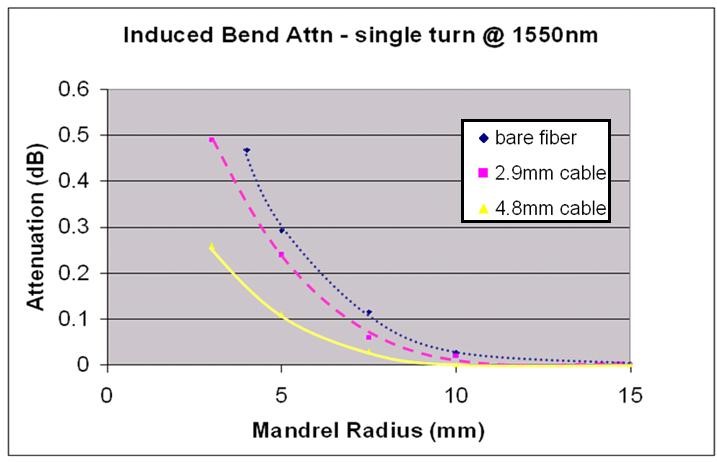
The significance of the first two principles (optical fiber design & optical cable design) is demonstrated in Figure 1.
Cable Design

The development of bend-insensitive single-mode optical fiber has enabled solutions to many routing issues arising from MDU applications. Mandrel wrap characterization is typically used as a standardized comparison method for bend performance. Bend-insensitive fibers in three different configurations have been measured/graphed in Figure 1 for consideration. The bare fiber performance establishes the baseline on which the cable structure is built. The two cable performance characterization graphs document the improvement in induced-bend performance achieved by adding a protective cabling structure around the fiber. The “standard-duty” (2.9mm cable) is more bend-tolerant than the bare fiber. Nevertheless, the even more robust “heavy-duty” or “ruggedized” (4.8mm cable) provides significant improvement at bend radii approaching 5mm. Single fibers within these cable designs are also tight-buffered 900µm, featuring Prysmian’s ezStrip™ technology to ensure fast, worry-free performance in the field.
Both the standard-duty and ruggedized cables feature Aramid-strength yarns, as is common in everyday Interconnect cordage (patch cables). The presence of aramid is a key factor in enabling robust field terminations, whether using mechanical or splice-on connectors. 2.9mm and 4.8mm connector boots are widely available in the market today. The main difference with MDU cable is the introduction of Indoor/Outdoor jackets, which are critical for placing these fibers on the exterior of an MDU or SFU. For flame retardance, both Plenum and Riser versions are available with select environment types.
Optical Performance
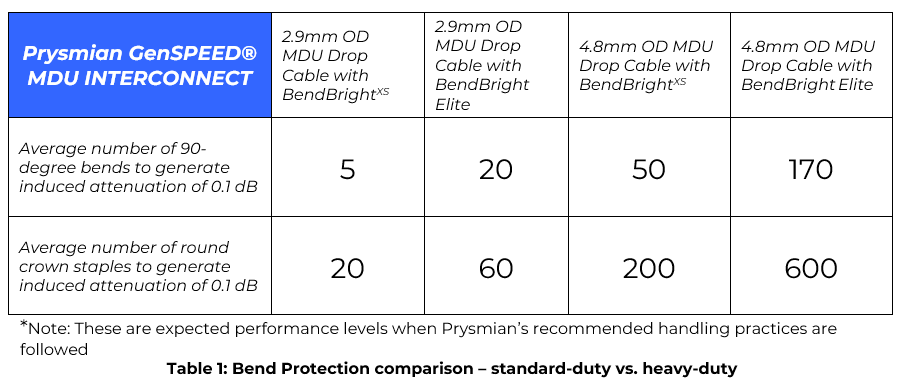
Can the differences between a standard-duty product and a heavy-duty product be significant? A performance characterization study was conducted to evaluate the influence of a series of sequential 90-degree bends of increasing severity on two cable structures (standard-duty and heavy-duty). To further demonstrate the impact of fiber design and cable design on performance, two different bend-insensitive fiber designs were also considered in this study. The first design is the “bend-insensitive” fiber BendBrightXS, and the second is the “ultra bend-insensitive” fiber BendBright-Elite.
Both optical fiber designs comply with the international standards G. 657A/B and G.652D. The BendBrightXS fiber is 100 times better than standard SMF in bending performance and will fulfill the system requirements for most MDU applications. BendBright-Elite delivers even better performance for extremely demanding applications and should be used on a case-by-case basis due to its higher cost. Table 1 below provides a performance characterization of the different configurations. Product selection will be based on several factors, including cost, available routing paths, and aesthetics.
Installation Practices
The focus of the third principle (installation practices) should be on enabling easy installation with minimal complications for installation personnel. Ideally, simple methods will be established that ensure consistency and account for the performance attributes/limitations of the cable product selected for use by the service provider. Typically, MDU applications utilize a fiber drop cable between the closest service distribution point and the living unit. This drop cable should ideally support rapid, easy, and cost-effective deployment; minimize the impact on visual aesthetics; and support an “out-of-sight / out-of-mind” dynamic. Service provider preference will dictate the priority between concealment and robustness and ultimately guide the installation practices to be adopted. The key concept to understand involves the ability to weigh the importance of aesthetics relative to installation.
Further details regarding aesthetics, the most common color options for MDU cables are Black and Ivory/Off-white. It is important to share these color options with the building owners to ensure compliance with site-specific requirements.
The most common installation method for the MDU Interconnect fiber is placing the cable in flame-retardant premise microducts. The most common sizes are 8.5/6mm and 12.7/10mm, available as empty or preinstalled with a pull string or drop fiber. Microduct pathways offer permanent in-wall protection of the fibers, offering ideal protection, maintenance and flexibility for growth.
The expectation for MDU drop cable applications is that heavy-duty designs provide a more protected environment for the optical fiber than standard-duty drop cables. Still, the consequences of using such a product are a higher cost and reduced suitability for “blending in.” The primary decision factor depends on the ease of adopting standardized installation practices in a local system. Standardization helps narrow product requirements, which, in turn, enables product selection. Standardization may also enable the establishment of consistent practices that minimize the need for a more rugged “insurance policy” product and reduce start-up costs.
Having this tiered product offering allows Prysmian to provide a variety of solutions to match the diverse range of MDU designs that exist today and will be built in the future. This approach enables operators to engineer their systems and maintain a cost-conscious approach properly.
Summary
A variety of application challenges are anticipated for MDU deployments due to the seemingly limitless configuration options created by different architectural designs and styles. Drop cables designed and built to meet different durability performance standards will be the order of the day to assist deployment economics. New cable performance standards that replicate anticipated installation forces must augment existing cable tests. The selected solution must include a balanced combination of optical fiber bend-insensitivity, a cost-effective cable design that meets the rigors of the application, and adherence to appropriate installation practices. An unbalanced approach adds unnecessary expense and ultimately reduces the effectiveness of MDU FTTH deployments in general.
To learn more about application considerations for MDU Drop Cables, contact our team of cable industry experts.
Media relations

Lauren Kane
External Communications Manager, North America
- phone+1 859.572.8825
- email[email protected]
Media relations

Anna Wright
Vice President of Marketing & Communications, North America
- phone+1 859.572.8793
- email[email protected]