


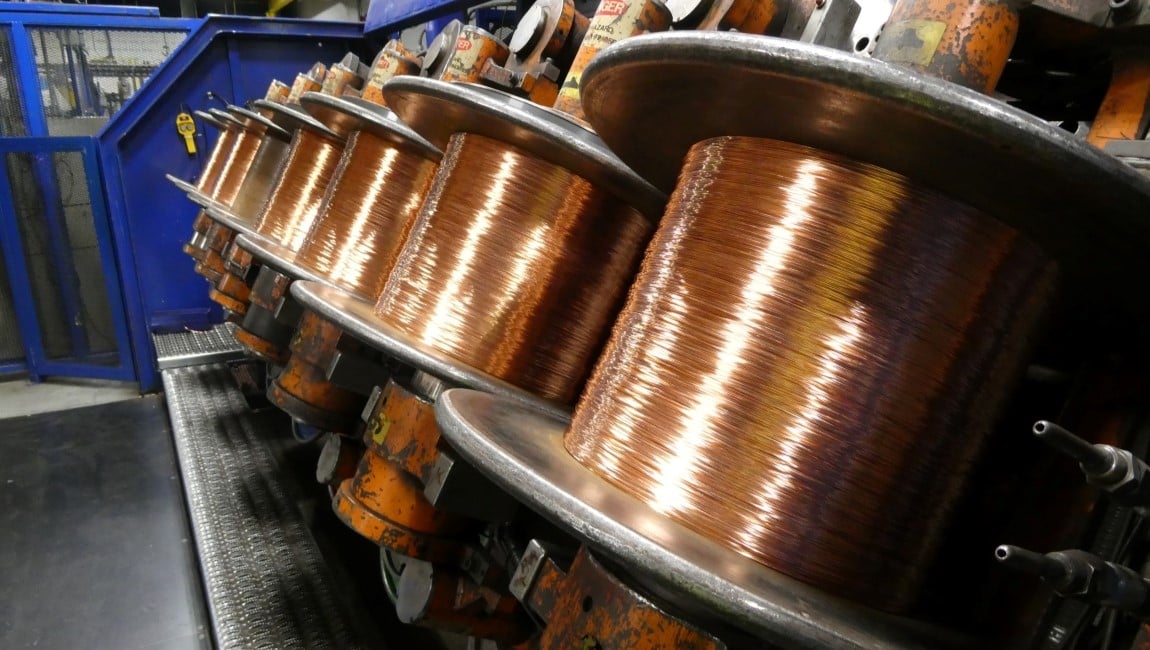
Beyond Output: How Prysmian Measures Manufacturing Success
Paul Furtado, COO of Prysmian North America, shares how manufacturing success is driven by leadership, culture, and repeat business, all sustained through disciplined execution and an agile, growing network.
Prysmian’s definition of manufacturing success starts with something deceptively simple: delivering consistent, reliable performance that keeps customers coming back. That mindset shapes how the company acquires, integrates, and operates more than 50 facilities across North America, spanning markets from traditional construction wire to offshore wind and data centers.
For Paul Furtado, Prysmian’s chief operating officer for North America, manufacturing success is not just about output but about the “quality of service” delivered in a way that is sustainable over time. That shows up as on-time, to-spec product and the kind of performance that earns repeat orders “day in, day out,” rather than one-off wins. Inside the plants, that philosophy becomes discipline in execution, strong local ownership, and a culture where leadership drives behavior, behavior drives culture, and culture drives performance.
Prysmian keeps score with a full slate of KPIs. Still, Furtado is wary of letting metrics “lead you down the wrong path.” Hence, he calibrates success against a longer arc: where the business stands now versus, say, in 2012, when Prysmian’s first major wave of acquisitions in North America began. The test is whether customers still depend on the company as a trusted partner and whether plants can deliver the same level of performance month after month, even as markets shift around them.
Acquisitions as a Two-way Street
Over the past 15 years, Prysmian has stitched together a North American manufacturing footprint through acquisitions such as Draka (2011), General Cable (2018), and, more recently, Encore Wire (2024). The company’s integration playbook is deliberately simple: “seek to understand,” protect what made the acquisition target successful, and then replicate the best practices across the network without imposing a single “Prysmian way.”
As Furtado explains, Encore Wire brought a best-in-class service model built on speed and agility, including a tightly integrated production and distribution process that set a high bar for responsiveness. Prysmian has been explicit about not diluting that advantage; instead, the company is using Encore’s approach to raise the standard across its North American plants, particularly on response times and service levels. General Cable, which brought North American relevance, added 20-plus plants and a broad energy and communications portfolio when Prysmian acquired it, contributing experience, people, and process depth that the combined company has folded into its operations and R&D footprint.
“The hard part is consistency,” Furtado explains. “It is one thing to turn around a single facility; it is another to achieve repeatable performance across dozens of plants with different histories, systems, and cultures.”
Furtado’s answer is to put accountability as close to the shop floor as possible, decentralizing decision-making so local teams can act quickly while still aligning with a regional strategy.
Balance, Resilience, and the Long Game
Prysmian’s North American network of 50-plus manufacturing, distribution, service, and R&D facilities generating more than $9 billion in sales gives it a scale advantage in both product range and geographic coverage. That scale is not just about serving more customers; it is about building a portfolio that can flex as markets rise and fall.
Data centers are surging, fueled by digitalization and cloud growth, and Prysmian can supply a wide range of cables and systems for those projects.
At the same time, there is a renewed push for electrification and grid modernization in North America, and Prysmian’s transmission, power grid, and high-voltage offerings position the company to help upgrade the infrastructure that feeds those same data-hungry facilities. On the renewable side, offshore and onshore wind, solar, the company has become a major supplier of subsea and high-voltage cables, even as policy changes and shifting incentives have made the space more volatile.
Resilience, in that context, means continuing to invest in plants and people even when a given segment cools. Furtado points to the pandemic period as an example in which Prysmian kept its workforce intact and continued to back businesses that were not “booming” at the time, reflecting a long-game strategy rather than a purely short-term, demand-driven approach. That same resilience shows up in the way Prysmian navigates political shifts affecting renewables: when incentives retreat, the company leans on its diversified portfolio rather than exiting the space.
Furtado often reaches beyond manufacturing for analogies, including the Dallas Cowboys’ long drought since their early-1990s dominance. The lesson he draws is that organizations cannot rely on old formulas in a changing environment. For Prysmian, that means deliberately revisiting its own legacy practices when new acquisitions reveal “a better mousetrap,” whether in safety culture, speed, or market outreach.
The leadership model follows a clear sequence: start with strong leaders, build the right culture, and let that culture drive performance. That is why the company emphasizes local ownership in its plants, even as it thinks globally about portfolio and strategy. The organization prizes focus—having a strategy you believe in, then prioritizing and executing it with discipline—while keeping its “head on a swivel,” ready to pivot when markets, technologies, or policies shift.
Wire and cable may not be what many outsiders might label “attractive.” Still, Furtado argues that it is fundamental to everything from cell phones and electric vehicles to offshore wind and data centers. For Prysmian, manufacturing success in that context is not a single metric or milestone; it is the ongoing ability to adapt, integrate, and deliver reliably in a world that increasingly runs on electrons.
How Prysmian Defines Manufacturing Success
- Success equals repeat business, not just output. Prysmian frames manufacturing success as delivering consistent, reliable performance that earns ongoing orders—not just hitting volume targets for a single quarter.
- Leadership first, KPIs second. The company tracks plenty of KPIs, but its internal formula is: strong leadership builds the right culture, and that culture delivers the performance the numbers only confirm.
- Think globally, act locally. With a broad North American footprint, Prysmian pushes ownership down to the plant level, enabling sites to remain agile and responsive while still aligning with global and regional strategies.
- Integrations are two-way learning. Acquisitions such as Draka, General Cable, and Encore Wire are treated as sources of best practice—not just assets to be absorbed—so the “best of both” gets replicated across the network.
- Speed and service as differentiators. Encore’s fast, vertically integrated service model is being used as a benchmark to sharpen responsiveness and lead times across Prysmian’s North American operations.
- Resilience through balance. A diversified portfolio—serving construction, electrification, data centers, and renewables—helps Prysmian keep investing in plants and people even when individual segments soften or incentives shift.
- No resting on past wins. Markets, technologies, and policies move too fast for legacy playbooks; Prysmian treats “what worked five or ten years ago” as a starting point, not a destination, and continuously adapts its manufacturing approach.
In a rapidly evolving industry, Prysmian’s commitment to adaptability and long-term partnerships ensures it remains a leader in manufacturing excellence.
Media relations

Lauren Kane
External Communications Manager, North America
- phone+1 859.572.8825
- email[email protected]
Media relations

Anna Wright
Vice President of Marketing & Communications, North America
- phone+1 859.572.8793
- email[email protected]