


Closing the Loop on Emissions: A Circular Way to See Impact
By Flavia Pane, Sustainable Solutions & Product Development Senior Engineer, R&D, Prysmian North America
What if most of our emissions don’t even come from our factories? When discussing carbon reduction, many picture smokestacks or energy-hungry plants. The reality is more complex—and more significant. Carbon emissions occur throughout the entire value chain, from raw materials to product use and end-of-life, across all industries. At Prysmian, we go further: by adopting a holistic Circular Economy approach, we actively manage, reduce, and rethink emissions at every stage. Here’s how we do it.
A Simple Way to Look at Emissions: Follow the Journey
If you look at the Prysmian value chain (see image below), you can trace a product’s life:
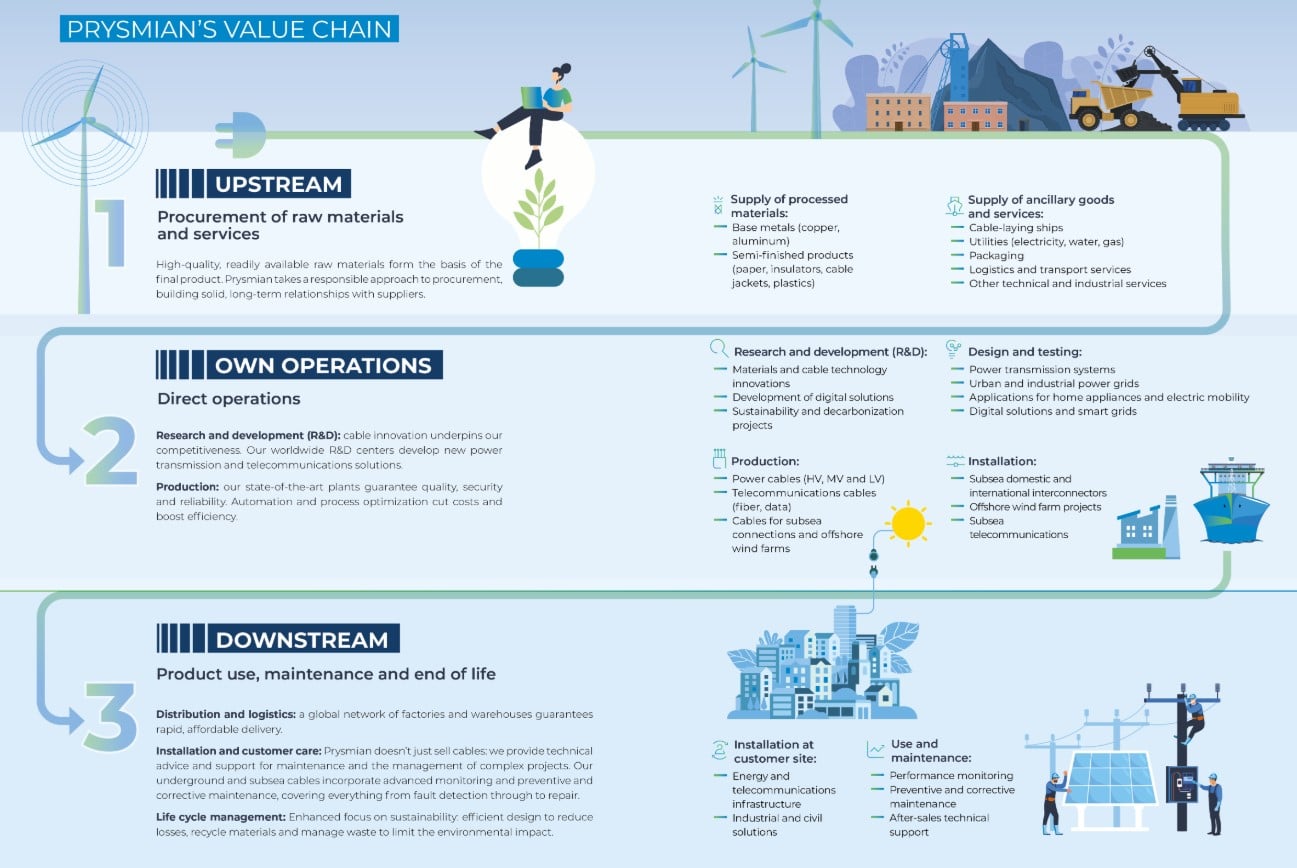
- Upstream: where raw materials come from.
- Our operations: where we design and manufacture.
- Downstream: where customers install and use our solutions.
Now layer emissions onto this journey, and you get three categories defined by the GHG Protocol:
- Scope 1: direct emissions from sources we own or control
- Scope 2: indirect emissions from the energy we purchase
- Scope 3: all other indirect emissions across the value chain
Now that we’ve mapped the journey, let’s walk through each part and how we are already taking action in North America.
Operational Decarbonization (Scopes 1 and 2)
Verified emissions data from the 2025 Integrated Annual Report show that Scope 1 and Scope 2 together account for less than 1% of Prysmian’s total emissions. Only a small fraction comes from our direct operations. Here’s what Scope 1 and 2 mean:
- Scope 1: Our direct footprint. Officially, these are emissions from sources owned or controlled by the company. In simple terms, it’s what happens within our walls—fuel used in processes, on-site equipment, and company operations.
- Scope 2: The energy behind our operations. Officially, this covers emissions from generating purchased electricity, heating, and cooling. In simple terms, it’s the invisible footprint of the energy we rely on. Even if emissions happen off-site, they’re tied to how we power our operations.
Here’s how we are taking action in North America with respect to Operational Decarbonization:
- On-site EV charging infrastructure: Supporting the transition to electric mobility for employees and future fleet electrification.
- Boiler upgrades: Improving the efficiency of thermal systems to reduce fuel consumption and energy loss.
- Electric forklifts: Replacing combustion-based equipment with electric alternatives to reduce both direct and indirect emissions.
- Natural gas reduction initiatives: Process optimization and partial electrification to reduce reliance on fossil fuels.
- Chiller replacements: Introducing newer, more energy-efficient cooling systems that lower electricity demand.
- Energy management systems (heating and cooling): Using smarter controls and monitoring to optimize plant conditions and eliminate inefficiencies.
- Solar farm: Deploying on-site renewable energy to reduce emissions from purchased electricity directly.
Scope 3 – The Biggest, Shared Challenge
Scope 3 extends beyond our direct control, and this is where the real opportunity emerges. It’s not just about what we do, but what we influence together.
Over 99% of Prysmian’s total emissions fall under Scope 3, with roughly 94% from product use (downstream) and around 5% from raw materials (upstream). A significant portion of this downstream impact is linked to energy losses during power transmission and distribution over the lifetime of our cables. This is where two key levers emerge: improving the efficiency of the cables themselves (through solutions such as E3X® technology, optimized conductor sizing, and higher conductivity materials) and supporting the transition toward lower- or zero-carbon energy sources. Together, these actions can substantially reduce emissions across the use phase.
The percentages shown above highlight a critical shift: decarbonization is not just about how we run our plants; it’s about how we design, source, and enable our products across the entire value chain. This value-chain perspective is also at the core of Prysmian’s Climate Transition Plan. The plan recognizes that meaningful decarbonization requires action across all emission scopes, combining operational improvements, responsible sourcing, product innovation, and collaboration throughout the value chain. The initiatives highlighted in this article are examples of how that strategy is being translated into action across North America, helping advance Prysmian’s ambition to support the energy transition while reducing the impact of our products and operations.
Let’s now have a look at the two components that make up Scope 3:
- Scope 3 Upstream: The impact of what we source. Officially, these are emissions from producing purchased goods and services—including raw materials, components, and supplier activities. Simply put, it’s the footprint embedded in everything we buy. These emissions occur before materials reach our operations but are directly tied to our sourcing and design choices.
- Scope 3 Downstream: The impact beyond our operations. Officially, this means emissions that occur after our products leave our control—including distribution, use, maintenance, and end-of-life. In simple terms, it’s the footprint of how our products are used. These emissions depend on how customers install, operate, and manage our products over time, making product design a powerful lever for change.
Even before production begins, our impact is present. That’s why we focus on transforming materials and using:
- Low-carbon Aluminum: Sourcing from suppliers who use low-emission production processes (such as renewable-powered smelting) to reduce embodied carbon at the source.
- Recycled Copper: Using secondary copper streams to avoid energy-intensive primary extraction while maintaining product performance.
- Recycled Steel: Increasing use of low-impact steel produced via electric arc furnace routes.
- Recycled PET Tapes: Reducing virgin plastic use and supporting circular material flows through recycled content.
- Recycled Plastic Flanges: Extending circularity to packaging (spools) and auxiliary components, not just core products.
Once our products leave the factory, our direct control naturally decreases, but that doesn’t mean our impact ends there: this is where some of the biggest opportunities begin. This is where design becomes a powerful lever. By embedding sustainability into how we design our products, following our Design For Sustainability (D4S) framework and E-Path labeling system, we can influence how they are installed, used, maintained, and ultimately managed at the end of their life. In other words, we can help bridge the gap between what we control and what we can influence. Designing with transmission efficiency, durability, and lifecycle performance in mind enables our products to help reduce emissions beyond our own operations. Because sustainability doesn’t stop at the factory, it continues through product use. One strong example of this is the previously cited:
- E3X® coating technology: A proprietary coating applied to Bare Overhead Conductors that enhances cable durability and performance, which in turn:
- Extends product life
- Reduces maintenance needs
- Lowers lifecycle emissions for customers
Connecting the Dots: A Circular Way of Thinking
When you look at all this together, a pattern emerges. This is not a linear system; it’s a loop:
- Reduce impact at the source
- Improve how we operate
- Design better products
- Keep materials in use
And most importantly, work together across the value chain.
Why Partnerships Matter
We can act directly on Scope 1 and Scope 2. But Scope 3 requires collaboration because sustainability is not a silo; it’s a system challenge:
- With suppliers to transform materials and supply superior environmental products
- With customers to improve product performance and lifecycle
- With universities and external partners to accelerate research, innovation, and new sustainable solutions
- Across teams to promote knowledge sharing, cross-fertilization and technology transfer and to scale ideas
A Platform to Turn Ideas into Action
The North America Sustainability & Innovation Committee plays a key role in making this real. It acts as a leveraging platform to:
- Track and prioritize sustainability projects
- Connect ideas with the right stakeholders
- Accelerate initiatives from concept to execution
- Expand focus beyond emissions into circularity, innovation, and compliance
Closing the Gap Together
This is where every idea counts. Progress doesn’t always start with big investments; it often begins with a better process, a smarter material choice, a missed inefficiency, or simply a different way of thinking. Closing the gap is not about one initiative; it’s the result of everything we do, every day, across the value chain.
So, the real question becomes: what could we do differently, where do we see opportunities to improve, and what are we not seeing yet? Whether it’s an idea already taking shape or just a starting point that needs direction, every contribution matters.
This is an open invitation to start the conversation, share perspectives, and build on each other’s ideas, because real progress doesn’t come from isolated actions; it comes from all of us working together to decarbonize our value chain. Every project and every improvement contributes to turning Prysmian’s Climate Transition Plan into reality.
Let’s turn ideas into action together.
Media relations

Lauren Kane
External Communications Manager, North America
- phone+1 859.572.8825
- email[email protected]
Media relations

Anna Wright
Vice President of Marketing & Communications, North America
- phone+1 859.572.8793
- email[email protected]