


Aluminum Armored Cable: Benefits and Applications
Learn how aluminum armored cable delivers superior protection and cost savings for commercial, industrial, and utility installations.
Every commercial, industrial, and utility project depends on cables that survive years of mechanical stress, environmental exposure, and operational demands. The choice of cable can make or break a project's success, affecting everything from initial investment to long-term maintenance expenses. Aluminum armored cable has become a preferred solution for many installers and distributors, offering an optimal balance of protection, performance, and value. These cables provide robust mechanical protection against physical damage while maintaining the electrical characteristics needed for power, control, instrumentation, and datacom applications. Single-pull installation eliminates the time and cost of separate conduit runs.
What Is Aluminum Armored Cable?
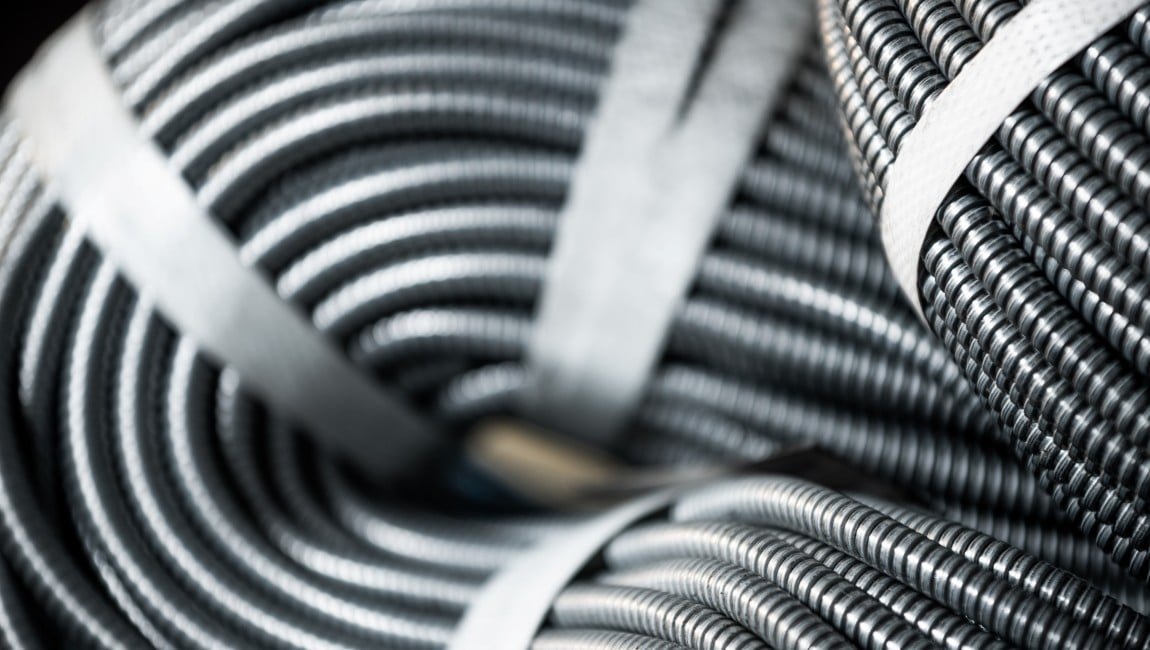
Aluminum armored cable features a protective metal layer wrapped around the cable core, providing mechanical strength and shielding against external threats. Construction begins with copper or aluminum conductors, insulated with materials suited to the specific application. Around these insulated conductors, manufacturers apply an aluminum armor layer using one of two armoring techniques: interlocked armor and continuously corrugated welded armor. Each one is engineered for specific environments and performance demands.
Interlocked armor represents the most common method of aluminum armoring. Manufacturers wind a continuous aluminum strip in a helical pattern, with each turn interlocking with the previous one. The result is a flexible yet strong protective barrier that can bend around corners while resisting crushing forces and physical impacts. The interlocking design allows the cable to maintain flexibility during installation, making it easier to route through buildings, industrial facilities, and outdoor environments.
For environments where even greater protection is needed, continuously corrugated welded cables feature a continuously welded corrugated aluminum sheath that is completely impervious to gases, liquids, and vapors. An outer jacket covers the aluminum armor, typically made from polyvinyl chloride or other durable polymers. The jacket protects the metal armor from moisture, chemicals, and environmental exposure while providing electrical insulation. The aluminum armor serves multiple functions beyond physical protection; it acts as a ground path, provides electrical safety in the event of conductor failure, and offers some degree of electromagnetic shielding.
Manufacturers produce aluminum armored cables in various configurations to meet different voltage ratings, conductor sizes, and application needs. Power cables, control cables, and instrumentation cables all benefit from aluminum armor protection.
Aluminum Armor vs. Steel Armor: Choosing the Right Construction
The armor material itself is a key decision point for installers and distributors. Two of the most common options in the industry are aluminum and steel, and each has distinct advantages depending on the application.
Aluminum armor is significantly lighter than steel. Steel armor can weigh 10 to 40 percent more than its aluminum equivalent, depending on the cable construction. That weight difference simplifies handling, reduces labor time, and lowers strain on support structures during installation. Aluminum also forms a natural oxide layer when exposed to air, giving it strong corrosion resistance without additional treatment. For most commercial and industrial applications, aluminum armor delivers outstanding protection at a lower installed weight, making it the practical choice for most projects. For wet or outdoor installations, an outer jacket is required on the interlocked armor.
Steel armor offers superior crush resistance and tensile strength, making it the right choice for environments with extreme mechanical stress.
In most applications, both armor materials provide equally sufficient protection. The right choice comes down to the specific mechanical demands, installation environment, and project requirements.
Applications for Aluminum Armored Cable
Power and Control
Manufacturing plants, refineries, processing facilities, commercial buildings, and utility projects all depend on reliable power and control cables. Aluminum armored cable excels in these environments, protecting conductors from impact, crush, and abrasion without requiring conduit. The cables route along floors, through walls, and in cable trays across a wide range of voltage levels from 600 V to 35 kV. Chemical resistance becomes critical in many industrial settings, and the combination of aluminum armor with appropriate jacket materials provides excellent defense against oils, solvents, and other harsh substances.
Instrumentation and Process Control
Oil and gas facilities, chemical plants, petrochemical refineries, and offshore petroleum installations, in addition to power and control, need cables that deliver reliable signal transmission while withstanding explosive atmospheres and aggressive environmental conditions. Continuously corrugated welded Aluminum armor cables meet stringent requirements for Class I, II, and III hazardous locations, and Zone 1 and 2 installations. The continuously corrugated welded aluminum sheath provides an impervious barrier to gases, liquids, and vapors, while the shielded construction blocks electromagnetic interference from corrupting sensitive process control signals.
Datacom and Structured Cabling
Office buildings, hospitals, schools, data centers, and campus environments benefit from aluminum armored datacom cable wherever structured cabling runs through exposed locations, high-traffic areas, or spaces where conduit is impractical. The interlocked aluminum armor provides outstanding mechanical protection while the cable maintains the electrical performance modern network applications require.
Outdoor and Utility Applications
Jacketed aluminum armored cable handles the rigors of outdoor installations with equal reliability. Direct burial, aerial runs on messenger wire, and utility distribution all benefit from the armor's resistance to moisture, ground movement, rodent damage, and physical impact. Both interlocked armored and continuously corrugated welded cables are rated for outdoor use, wet locations, direct burial, and aerial messenger installations, making them dependable choices for demanding outdoor and utility environments.
Safety and Compliance Considerations
Aluminum armored cables must meet extensive safety standards to ensure reliable performance and protect personnel. The National Electrical Code (NEC) establishes fundamental installation requirements, specifying where and how armored cables can be used. Article 330 covers metal-clad cable, including aluminum-armored varieties, and details installation methods, support requirements, and bending-radius limitations.
Cables can have various levels of flame resistance. The installation location determines the minimum flame-resistance rating.
Grounding and bonding of aluminum armor are in accordance with established electrical codes. Continuously corrugated welded armor can serve as an equipment grounding conductor when properly sized and terminated. Installation methods must ensure electrical continuity of the armor throughout the cable run, providing a safe path for fault currents.
Environmental ratings indicate the conditions where cables can reliably operate. Temperature ratings specify the maximum operating and installation temperatures, while moisture resistance ratings determine suitability for wet or dry locations. UV-resistant jackets prevent degradation from prolonged sun exposure in outdoor installations.
Advantages of Aluminum Armored Cable
Superior Mechanical Protection
The interlocked aluminum armor provides exceptional defense against physical damage. Crushing forces that would destroy standard cables barely affect properly specified armored cables. Impact resistance prevents damage from dropped tools or equipment, while abrasion resistance allows cables to withstand constant friction against rough surfaces. The armor absorbs mechanical stress, protecting the conductors and insulation within.
Cost-Effective Installation
Aluminum armored cable eliminates the need for conduit in many applications, delivering significant cost savings. The lighter weight of aluminum armor reduces shipping costs and makes handling easier, allowing projects to be completed faster.
Versatile Application Range
A single cable type can serve multiple installation environments. Aluminum armored cables work indoors and outdoors, in wet and dry locations, buried directly in earth, mounted on messenger wire, or installed in cable trays. The cables handle power, control, instrumentation, and datacom applications, simplifying specification, procurement, and inventory management for distributors and contractors.
Enhanced Durability
Aluminum armored cables provide long service life even in demanding conditions. The armor protects against rodent damage, preventing costly failures from gnawed cables. Environmental resistance keeps cables functioning through temperature extremes, moisture exposure, and chemical contact. The robust construction reduces maintenance needs and prevents premature replacement, making these cables a smart long-term investment.
Price, Lead Time, and Stocking Guidance for Distributors
Aluminum armored cable pricing varies based on conductor size, conductor count, voltage rating, and special features. Power cables with larger conductors cost more per foot than control or instrumentation cables with smaller conductors. Cables with individual and overall shields cost more than unshielded variants.
Availability depends on cable specifications and project requirements. Stock availability varies by construction type, with some configurations more readily available than others. Working directly with manufacturers helps ensure access to the right cables when projects demand them.
Stocking decisions should balance inventory carrying costs against the ability to respond quickly to customer needs. High-volume items justify larger inventory positions. Common conductor sizes, voltage ratings, and jacket colors typically see higher demand than specialty items. Geographic factors influence stocking decisions, with certain industries concentrated in specific regions.
Package configurations influence handling and storage. Smaller lengths suit contractor demand for modest-sized projects, while larger reels better serve major installations. Some distributors maintain inventory in multiple formats to cater to their customers' diverse needs. Proper storage protects cable quality, with indoor storage preventing exposure to moisture and temperature extremes.
Contact Prysmian for Armored Cable Solutions
Prysmian leads the global cable industry with comprehensive solutions engineered for the most demanding applications. Our armored cable portfolio spans power, control, and instrumentation, each designed to deliver reliable performance in challenging environments. With manufacturing facilities across North America, we produce cables that meet rigorous quality standards while supporting domestic supply chains.
Every cable we manufacture undergoes extensive testing to verify compliance with industry standards and performance specifications. Our technical team works closely with customers to determine the optimal cable configuration for each application, taking into account environmental conditions, electrical requirements, and installation methods.
Contact our team of cable industry experts to learn more about how our aluminum armored cable solutions can meet your project needs.
Media relations

Lauren Kane
External Communications Manager, North America
- phone+1 859.572.8825
- email[email protected]
Media relations

Anna Wright
Vice President of Marketing & Communications, North America
- phone+1 859.572.8793
- email[email protected]